
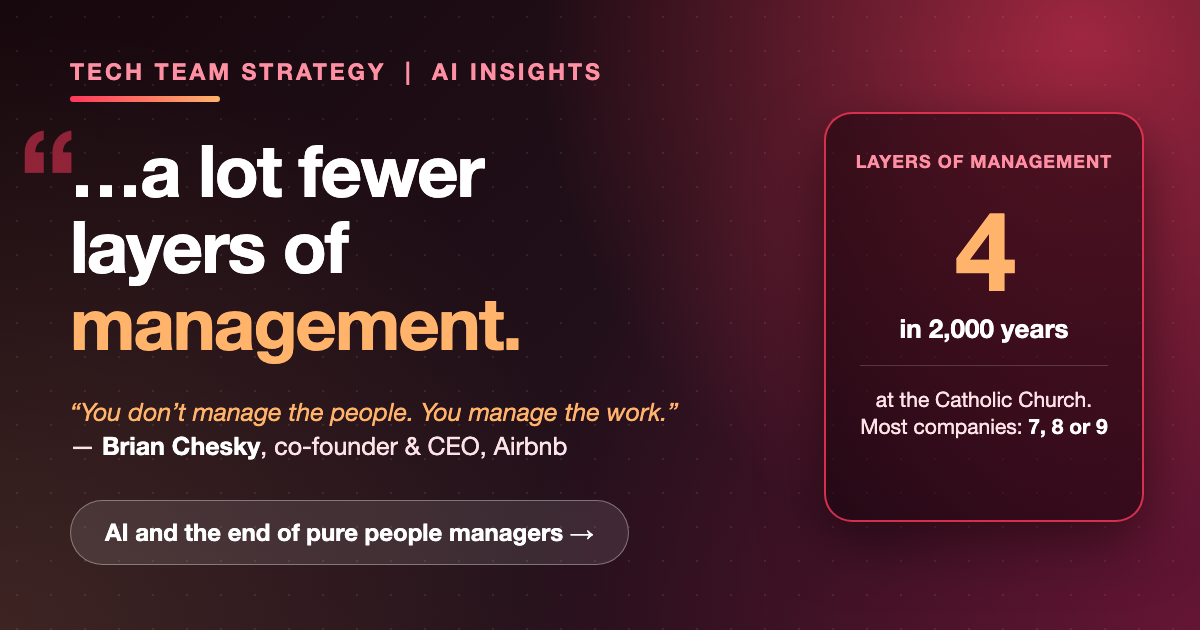
What happens to managers when AI arrives? Brian Chesky, who co-founded Airbnb on three air mattresses and built it into a company that handles nearly $100 billion in bookings a year, has a clear answer: fewer layers, and no room for managers who only manage people. "You don't manage the people. You manage the work."
In an 83-minute conversation with Patrick O'Shaughnessy on Invest Like The Best, published on May 5, 2026, Chesky explains how he is redesigning Airbnb for the AI era. He also covers how he lost control of the company and got it back, the tiny teams that now drive its growth, and why he thinks consumer AI is the next big prize.
This article is our own summary, written for owners and leaders of growing businesses. Statements below are as described in the interview and we have not independently verified them. Short quotes are lightly edited for filler words and transcription errors. Watch the full video above for everything that was said, and sign in to read the full transcript below the article.
Want the full playbook? Our detailed Executive Brief on Brian Chesky covers fourteen themes with his own quotes and timestamps, twelve key numbers, Airbnb's four bets, his hiring method, a 12-point checklist and a 30-60-90 day plan.
The short version
- Fewer layers of management. AI will mean flatter, more asynchronous companies. He expects every job at Airbnb to change.
- No place for pure people managers. Managers must stay hands-on: engineers still code, design leaders still design.
- Manage through the work. Not through recurring one-on-ones, and not as "people's therapists."
- Adapt or struggle. People who are rigid and unwilling to change are the other group he expects to have trouble.
- Founders are born; CEOs have to learn. Almost every CEO instinct is wrong, and trial and error is expensive.
- Audit before you delegate. Start hands-on, then "give ground grudgingly."
- Make the problem as small as possible. One team of 10 to 12 people delivered about $300 million in its first year.
- One market, then 10, then many. Product-market fit and scaling are different problems.
- Consumer AI is the next prize. He expects a consumer AI renaissance within 12 to 24 months.
- Hiring is the CEO's number one job. He spends two to three hours a day on it.
AI and the future of managers
This is the part of the interview every manager should hear. Chesky says AI will change how Airbnb is organized, and that he is still working out exactly how: "I'm in the middle of trying to think about how to redesign the company. I think every single person in this company's job will change." His approach is to get everyone using AI tools first, watch how each job changes, and then embark on "a fundamental redesign."
Fewer layers of management
In founder mode, Chesky ran Airbnb through in-person group reviews, with the whole chain of command in the room. With AI, he expects a shift to asynchronous work and a much flatter company (11:22):
"They're going to have a lot fewer layers of management." (Brian Chesky)
He uses an old saying to make the point: "The Catholic Church has been going on for 2,000 years, only have four layers of management. Why do every other company have like 7, 8, 9 layers of management?" He is not arguing for no structure at all. As a thought experiment he asks whether he could manage all 7,000 people flat, and answers: "I don't think that's a good idea. I think that's an extreme. But I do think going to a few layers of management would make a lot of sense."
No place for pure people managers
Chesky said pure people managers, those who only manage people and lack hands-on expertise, may not have a place in the AI era (12:39–15:15):
"I don't think people managers will have any value in the future. When I mean people managers, people that only manage people, I think everyone's going to have to be a hybrid." (Brian Chesky)
He expects managers to remain actively involved in their field: "Every engineer needs to code, even the managers need to code, and whatever the version of that is for your field." A lawyer who manages lawyers still has to "actually read the case law." Design leaders should still design: "Jony Ive manages the design. He designs and he leads people." In his words, leadership "is about content and leadership," not leadership alone.
Manage through the work, not one-on-ones
He argued that leaders should manage through the work, not rely mainly on recurring one-on-ones or act as people's therapists:
"You manage people through the work. You don't manage the people. You manage the work. Otherwise, what are you doing?" (Brian Chesky)
"You can't just be like these managers where you're kind of people's therapists, and you're just doing meetings, you're doing one-on-ones." Relationships still matter: a check-in or a dinner with a direct report a couple of times a year, asking about their family. "That's not a day-to-day thing. You're not their therapist."
Who will struggle, and who won't
He named two groups he expects to have trouble making the shift: "pure people managers and people that are rigid and don't want to change and evolve." For everyone else he is optimistic: "As long as you're like got a growth mindset, I think the tools are going to be very easy," because the economic incentive is for AI tools to become simple enough for anyone.
He wasn't saying all managers disappear. His point is that management needs to be combined with real functional or technical contribution: a hybrid of manager and individual contributor.
Better people need less managing
The same idea runs through how he hires. "As a leader, you can choose if you want to spend time hiring or managing, one or the other." The better the people, the less managing they need: "The more time you spend on recruiting, less time you spend on management, because the really good people just are self-managing." Fewer layers and better hiring go together.
No one is born a good CEO
Chesky's view is simple: being a founder is innate, being a CEO is not. "The job of CEO is completely counterintuitive, and almost all of your intuition about what to do is wrong." Founders learn by doing, but at the top, mistakes are slow and expensive: hire the wrong executive, "they build an empire, they leave, and now you get to unwind their empire, and it takes like four years."
By 2019, Airbnb had about 7,000 employees and he no longer recognized it:
"I felt like I was in a car without a steering wheel... I was like, turn left, and the company would go right." (Brian Chesky)
Then the pandemic hit, and Airbnb lost 80% of its business in eight weeks. Guided by Hiroki Asai, Steve Jobs' former creative director, Chesky took control of everything, worked 100-hour weeks and reviewed every detail for two to three years. The goal was never to micromanage forever: "How do you know they're great if you're not auditing what they're doing?"
Project Hawaii: a startup inside a big company
To recover the magic of the early days, Chesky built a team of 10 to 12 people (designers, engineers, a couple of product people, data scientists) with one goal: a better guest experience and higher conversion. They worked in stages: crawl (fix bugs), walk (new features), run (rethink the flow), fly (invent). By his estimate, the team delivered about $300 million in its first year and $400 to 500 million the next. Then the same model went to pricing, and to other teams.
Make the problem as small as possible
For years Airbnb felt like a one-hit wonder. When it launched services and experiences in 100 cities at once, they didn't work. The fix was in Airbnb's own history: it started in New York, Uber in San Francisco, DoorDash in Palo Alto. Now every new idea goes from one market, to 10, to many, and only then is industrialized.
"It's better to have 100 people love you than a million people sort of like you." (Paul Graham's advice, as Chesky recalled it)
"Instead of heating up an ocean, heat up a bathtub." Do things by hand, don't worry about the cost, prove the model, then scale. Airbnb now has 10 to 20 pilots running.
The 11-star experience
Five stars means nothing went wrong. Chesky's exercise keeps going: six stars is wine and a handwritten card, seven a car at the airport and a surfboard waiting, eight an elephant parade, nine a Beatles-style welcome, ten Elon Musk taking you to space. The absurd top end makes six or seven stars feel easy, and "that difference between the five and six star is probably different between you and a competitor."
Why consumer AI is the next prize
Of 175 companies in Y Combinator's last batch, 159 were enterprise. Chesky, who sits on YC's board, lists the reasons: fear that ChatGPT would kill consumer apps, no proven consumer business model, mature distribution, trend-following, and consumer simply being harder. "Almost every app on my home screen has not changed fundamentally since AI, including Airbnb. I think that's going to change in two years."
He also thinks AI moves people from consumption to creation: "Suddenly, all of us have a paintbrush and a canvas to make stuff."
What endures when software doesn't
Software ages fast. Chesky expects to look at today's Airbnb app in 10 years and think it looks dated. What lasts is the community, the network, the brand and the mission. "We're not building an app, we're not building a service, we're building a community." And: "I don't think there will be apps in the future. I think there'll be agents."
His plan for Airbnb's next chapter: make the person, not the home, the center of Airbnb (identity, preferences, a real-world social graph, a membership), expand from homes to 50 or more offerings, and disrupt Airbnb with AI before someone else does, without hurting the hosts and investors who depend on it.
Hiring is the CEO's number one job
Sam Altman told him early to spend half his time on hiring; not doing it was his biggest mistake. Today he calls his recruiter first and last every day and is co-hiring manager for the top 200 people. His method:
- Don't run searches; build pipelines. Meet great people before you need them, and ask each one for two or three more names.
- Start with results. Find great work, then find out who made it. Don't start with the resume.
- Reach further. Hire people so good they wouldn't join without the CEO's help.
Detach from adulation
The day after Airbnb's IPO, at a $100 billion valuation, Chesky woke up, put on sweatpants and joined a Zoom call as if nothing had happened. "Adulation is like a cup with the hole at the bottom." Now he works like an artist: "Don't try to be successful. Try to do something wonderful that you love for yourself." And his management philosophy comes from people who believed in him: "I saw potential in people they didn't see in themselves."
What to do with it in your business
- Count your layers. List every management layer and ask which ones AI tools and better people make unnecessary.
- Make every manager hands-on. Each leader should still do real work in their field: code, design, sell, read the case law.
- Manage through the work. Replace some recurring one-on-ones with reviews of the actual work.
- Pick one problem for a small team. Ten people, one customer goal, one metric.
- Work in stages. Crawl, walk, run, fly, and measure each step.
- Pilot in one place. One market or one segment before you expand.
- Write your six-star experience. Then build it.
- Audit before you delegate. Stay close to new leaders' work for the first months.
- Recruit every day. Keep a list of people you want to hire someday.
- Roll out AI with rules. Our AI Policy Pack gives your team clear rules for using AI tools safely.
Get the detailed Executive Brief
Our Executive Brief: Brian Chesky on AI Founder Mode, Small Teams and Redesigning Airbnb goes much further than this article:
- Why no one is born a good CEO, in his own words
- Twelve numbers worth remembering, clearly attributed
- Fourteen themes explained, each backed by short quotes with timestamps
- Airbnb's four bets, six lessons on innovating with small teams, and his hiring method
- A 12-point checklist, six leadership questions and a 30-60-90 day plan
- A quote bank of 20 more lines and a timestamped chapter guide
Video details
- Title: How Brian Chesky Is Redesigning Airbnb for the AI Era
- Host: Patrick O'Shaughnessy, CEO of Positive Sum (Invest Like The Best)
- Guest: Brian Chesky, co-founder and CEO of Airbnb
- Channel: Invest Like The Best on YouTube, about 114,000 subscribers
- Published: May 5, 2026
- Length: 1 hour 23 minutes 28 seconds
- Audience (as of October 30, 2026): about 181,000 views
- Category: People & Blogs
- Official description (excerpt): "Patrick O'Shaughnessy sits down with Airbnb CEO Brian Chesky to explore the critical shift from 'Founder Mode' to 'CEO Mode.'" It covers his path from industrial design student, the lessons of the pandemic, Apple's design philosophy, the 11-star experience, a consumer AI renaissance, pipeline hiring, and believing in people's untapped potential.
- Hashtags: #brianchesky #Airbnb #FounderMode #Leadership #Entrepreneurship #Tech #CEO #ArtificialIntelligence #Investing #Business #Growth #designthinking
- Presented by: Ramp
- Sponsors: Vanta, WorkOS, Rogo, Ridgeline
- Books mentioned: The Score Takes Care of Itself by Bill Walsh; Rick Rubin's book on creativity (The Creative Act)
- Watch: youtube.com/watch?v=eURcW5_uS60
Chapters
- 00:00:00 Intro
- 00:01:00 Studying Industrial Design
- 00:11:33 AI Founder Mode
- 00:17:02 Lack of Consumer AI Companies
- 00:22:10 Small Teams and Focused Problems
- 00:30:52 The Evolution from Founder to CEO
- 00:38:13 The 11-Star Experience
- 00:41:07 AI as a Canvas for Creativity
- 00:48:17 Detaching from Success
- 00:53:12 Founder-Led Moats
- 00:58:34 The Next Chapter of Airbnb
- 01:03:08 What Endures in the Age of AI
- 01:06:43 Lessons from Bodybuilding
- 01:10:20 The CEO's No. 1 Job
- 01:17:01 Activating Talent
- 01:20:39 The Kindest Thing
Want to put this to work?
We help owners and founders set up small, fast teams and put AI to work across the company. Book a free call or see our services.