
Most AI debates are about models. Alex Karp, co-founder and CEO of Palantir, says that is the wrong place to look: "It's not the model; it's what you do with the model." And for the companies paying the bills, he says the real cost of AI is hiding in plain sight.
In a 36-minute conversation with Leon Kalvaria, Global Chairman of Banking at Citigroup, published on Palantir's YouTube channel on October 23, 2026, Karp covers how he leads what he calls an "artist colony", why CEOs are livid about their AI spending, sovereign AI, the new security arms race, the politics of AI wealth, and the race with China.
This article is our own summary, written for owners and leaders of growing businesses. Statements below are as described in the conversation and we have not independently verified them. Short quotes are lightly edited for filler words and transcription errors. Watch the full video above for everything that was said, and sign in to read the full transcript below the article.
Want the full playbook? Our detailed Executive Brief on Alex Karp covers fourteen themes with his own quotes and timestamps, twelve key numbers, the full AI stack layer by layer, a 12-point checklist and a 30-60-90 day plan.
The short version
- AI has two costs. What you paid for the tokens, and the intellectual property you gave away to get them.
- Value is a delta. What can you do with AI that you could not do without it? Everything else is waste.
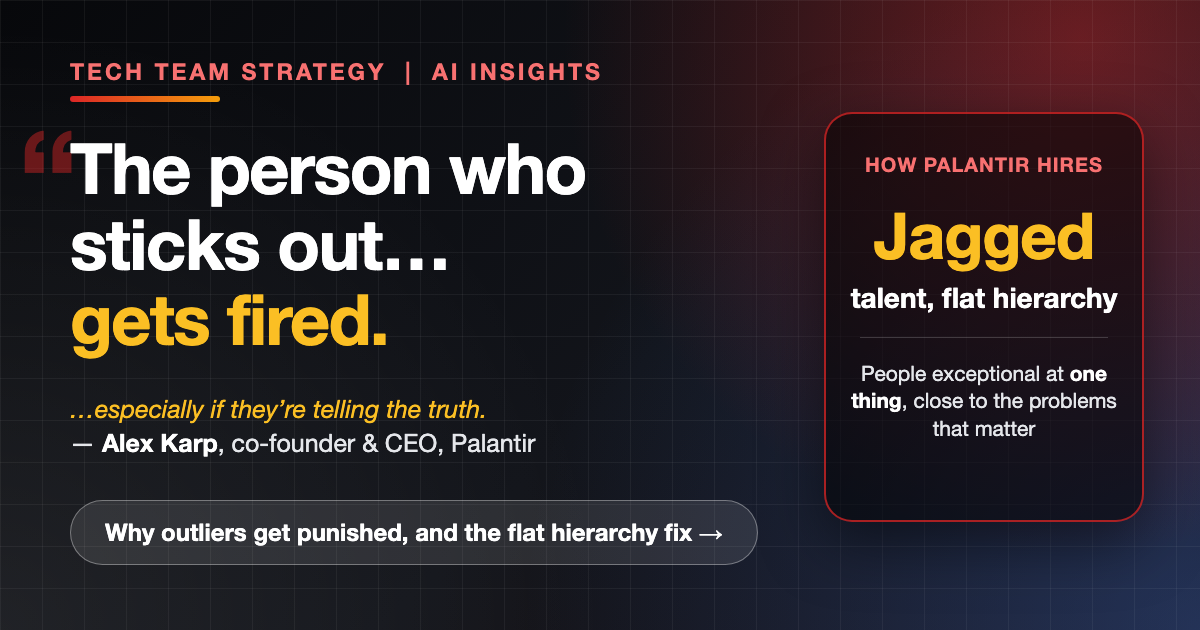
- Hire jagged people. Palantir looks for people exceptional at one thing and builds around them.
- Make room for dissent. Organizations punish people who stand out; leaders have to protect them and still use judgment.
- Keep the hierarchy flat. Few layers keep rare talent close to the problems that matter.
- Security is now guerrilla war. There is no 100% protection; the winner patches fastest.
- The biggest risk is political. AI creates enormous wealth, and pretending otherwise hands the issue to extremists.
- Wealth taxes won't fix it. He argues they kill startups and require a surveillance state.
- Whoever wins the tech race wins the world. The U.S. leads China by about six months: creativity against scale.
A creative leader running an "artist colony"
Karp studied philosophy at Haverford, law at Stanford and social theory in Frankfurt, then co-founded Palantir with Peter Thiel in 2003. Asked how that prepared him, he says: "I'm a primarily creative human being, and creative is different than pure execution." He also talks openly about being severely dyslexic, which he says helps him work faster and see ideas "outside of distribution", where most value comes from.
He calls Palantir an artist colony:
"We look for people who are unusually jagged." (Alex Karp)
The idea is to place each person where their rare talent is strongest and connect it to a problem that matters, usually with a societal hook. Done right, "you can build things that no one else can build."
Organizations punish people who stand out
Karp says organizations often punish people who stand out, especially when they tell uncomfortable truths. At 6:22, he argues that colleagues may struggle to accept someone who is much better at a particular skill or who sees things differently, and that such people can end up getting fired.
"The person who sticks out, who may be better at something, gets fired, especially if they're telling the truth at all." (Alex Karp)
"It's very difficult for humans to accept that there's a human that they're working with that is so much better at something that they can barely understand it." (Alex Karp)
He is not only talking about companies. He points to educational institutions too, and asks why Europe struggles to build a tech scene.
His point is that leaders need to make room for dissent and distinct talent, while still using judgment. He describes a young colleague telling him, in effect, "Dr. Karp, I think basically everything you've done is wrong," and adds: "They're not always right, so you have to manage that" (8:10–9:19). The real question, in his words:
"How do you insert yourself into their aptitude without destroying it, but while raising it?" (Alex Karp)
It is uncomfortable by design. Karp says harnessing this kind of talent has "a humiliation aspect" to it, and at Palantir people learn to read that discomfort as a sign something is working: "All medicine is kind of poison." Everyone says they welcome dissent; quoting Wittgenstein, he notes that "to believe you're following a rule is not to follow a rule."
Why Palantir keeps a flat hierarchy
Hiring unusually jagged people creates what Karp calls "a very difficult to manage environment." His answer is structural:
"We have a flat hierarchy to manage that." (Alex Karp, at 4:34)
Fewer layers keep the person with rare talent close to the problem that matters and close to the people who decide, instead of being filtered through levels of management that may not understand them. The flat structure serves one goal: connecting an important problem "to someone's n of one or n of very small number talent." That match, Karp says, is how Palantir built its work in anti-terror, battlefield software and AI integration for large institutions.
What it means for you: if your best people have to go through several layers to be heard, those layers filter out exactly the outliers you most need. As AI tools take over more coordination work, it is a good moment to ask which management layers still add value. (That last point is our takeaway, not something Karp said.)
Getting the first olive out of the jar
Great talent is not a business until customers adopt what it builds. Karp recalls the patriarch of the Crown family asking how Palantir got "the first olive out of the jar." His answer: forward-deployed engineers and leaders on the front line with clients.
"The trick is not just to get them to take the olive, but to change their taste so they appreciate the taste of the right olive." (Alex Karp)
What Palantir actually does for an enterprise
Kalvaria asks what Palantir solves that Accenture, SAP, McKinsey or Microsoft don't. Karp describes three layers:
- Foundry integrates all of a company's data, "a crucial step that does not happen" in many cases.
- Applications run the company's ideas on that data.
- Sovereign AI architecture lets a company power models it creates and owns, share them selectively or even white-label them, and capture its tribal knowledge "so you're not losing it."
The true cost of AI: what you paid and what you lost
This is the part every business owner should hear.
"Cost is a metaphor for two things: what did you pay and what did you lose?" (Alex Karp)
"The cost is not just what you paid for the token; it's what portion of your IP did you have to transfer to get the token." Some data doesn't matter: "No one cares really what you're doing in your marketing in Argentina." Other data must stay inside the company, such as how you organize your supply chain and which vendors you rate highly.
Value, in turn, "is going to come down to what is the delta between what you could do with or without this." That is why, he says, CEOs are angry: "They're paying for tokens that create no value, and they're doubly paying because some portion of their IP has been migrated to their competitor."
Security is now a speed contest
"It's going to be more guerrilla war." AI models can find security holes faster than organizations can respond. Citi aims for 100% safety; Karp's view is that society will have to accept "there is no 100% protection" and compete on how quickly it can find and patch unknown vulnerabilities. "These models are excruciatingly adept at finding attack vectors that a human would not be able to find."
It's not the model: the real risk is political
On whether AI is really about chips, energy and data centers, Karp says value comes from application, not the model. Then he turns to what he calls the elephant in the room:
"I think the primary risk to us in America is just political." (Alex Karp)
AI is a wealth creation machine. "Me being 20 times wealthier than I am now is a societal problem," he says, and telling voters that everyone else's wealth will grow 4% a year will not work. "Pretending we can just defer this issue just plays into the extremists."
But he rejects the popular fixes. A wealth tax, he argues, would "shut off innovation, kill the startups", while billionaires simply pay. It would eventually reach everyone with a net worth of a million dollars, and require a surveillance state that tracks every asset and gift, "the Pandora's box to no civil liberties protection." Public benefit corporations fail too: "First of all, you'd have to agree on what public benefit is." He cites Anthropic's Dario Amodei, whom he respects, as someone he would not agree with on that definition.
His broader point: "We are always solving political problems as if they're substantive problems, and substantive problems as if they're political problems." His test for any policy: "Has this ever worked in the history of humanity?"
The AI race: whoever wins the tech battles wins the world
"The people who won the tech battles, won the world." (Alex Karp)
Karp draws on Japanese and Chinese history to argue that technological leaders shape what happens for a very long time. Today, he says, only the U.S. and China really compete, with a minor exception in Israel. Europe will have to buy one of their stacks, and everyone else is "some weird derivative."
The U.S. lead is about six months. China's ability to refactor models for less compute, undercut pricing and distill is not going away, and the old caricature of an uncreative China is not holding. "Our advantage is creativity. Their advantage is scale." He also criticizes U.S. AI safety debates that ignore the competitive frame: "If we're lucky, we need to somehow eke out ahead."
What to do with it in your business
- Classify your data. Decide what can go to an outside model and what must never leave: supply chain, vendors, pricing, customer insight.
- Count both costs. For every AI tool, track tokens paid and IP exposed.
- Measure the delta. What can you do with the tool that you couldn't without it? Cut what creates no value.
- Integrate data first. Models are only as useful as the data they can see.
- Own what's proprietary. Rent general AI; keep models that touch your know-how under your control.
- Protect your outliers. Make it safe to tell you you're wrong, and keep layers few so the best people are heard.
- Put builders in front of customers. Adoption and product should shape each other.
- Test your security speed. Assume someone's model will find a hole. How fast can you patch it?
- Set rules for your team. Our AI Policy Pack gives your team clear rules on what data can go into which AI tools.
Get the detailed Executive Brief
Our Executive Brief: Alex Karp on Artist Colonies, the True Cost of AI and the Race with China goes much further than this article:
- The case that AI costs what you paid plus what you lost, in his own words
- Twelve numbers worth remembering, clearly attributed
- Fourteen themes explained, each backed by short quotes with timestamps
- The full AI stack, layer by layer, and six lessons on leading exceptional people
- A 12-point checklist, six leadership questions and a 30-60-90 day plan
- A quote bank of 20 more lines and a timestamped guide to the video
Video details
- Title: Palantir CEO Alex Karp on Life, Art, and Technology
- Guest: Alex Karp, co-founder and CEO of Palantir Technologies
- Host: Leon Kalvaria, Global Chairman of Banking, Citigroup (spelled "Leon Kalvara" in the video description)
- Channel: Palantir on YouTube, about 165,000 subscribers
- Published: October 23, 2026
- Length: 35 minutes 52 seconds
- Audience (as of October 30, 2026): about 155,000 views; likes are hidden and comments are turned off
- Category: Science & Technology
- Tags: Palantir, Palantir Technologies
- Official description: "Palantir CEO Alex Karp joins Leon Kalvara, Global Chairman of Banking, Citigroup, for a conversation on artistry, leadership, and the future of AI. They discuss building teams of unusually talented people, the push for Sovereign AI, the balance between innovation and wealth policy, and the geopolitical race to lead AI between the U.S. and China."
- Book mentioned: The Technological Republic, the No. 1 New York Times bestseller Karp co-wrote
- Products referenced: Palantir Foundry, Palantir Ontology, Palantir AIP
- Watch: youtube.com/watch?v=NDHeUx7nUbs
Conversation guide
The video has no chapters, so these times are our own.
- 00:00:00 Introduction: Karp's background and the sovereign AI movement
- 00:01:50 From philosophy and law to building Palantir
- 00:03:57 The direct listing and Palantir as an artist colony
- 00:06:22 Accepting people who are better than you
- 00:09:19 Defense, Maven and anti-terror work
- 00:10:28 Getting the first olive out of the jar
- 00:11:39 What Palantir solves for a large enterprise
- 00:13:08 The true cost of AI: what you paid and what you lost
- 00:14:50 CEOs livid about tokens that create no value
- 00:16:36 Security: guerrilla war with AI models
- 00:18:15 It's not the model; the political risk of AI wealth
- 00:21:28 Public benefit corporations and Dario Amodei
- 00:22:33 Political vs substantive problems
- 00:26:23 Wealth taxes, surveillance and civil liberties
- 00:28:21 The AI race between the U.S. and China
- 00:31:08 Europe, the full stack and a six-month lead
- 00:33:11 Creativity vs scale, and the time function
- 00:35:38 Close
Want to put this to work?
We help owners and founders decide which AI to rent, which to own, and how to keep their data safe. Book a free call or see our services.