
Most companies say they want to innovate. Josh Woodward, who runs Google Labs, the Gemini app and AI Studio, says the bar is now higher: "Every company definitely needs a set of people, a team. Their job is to be at the frontier."
In a 62-minute conversation with Lenny Rachitsky on Lenny's Podcast, published on October 11, 2026, Woodward explains how the world's longest-running big-company labs team finds ideas, spots product-market fit, kills projects, and avoids the fate of most corporate labs, which "fizzle out after about three to four years."
This article is our own summary, written for owners and leaders of growing businesses. Statements below are as described in the interview and we have not independently verified them. Short quotes are lightly edited for filler words. Watch the full video above for everything that was said, and sign in to read the full transcript below the article.
Want the full playbook? Our detailed Executive Brief on Josh Woodward and Google Labs covers fourteen themes with his own quotes and timestamps, twelve key numbers, the labs lifecycle, a 12-point checklist and a 30-60-90 day plan.
The short version
- Every company needs a labs team. What AI makes possible changes every few months. Someone has to find out first, before a competitor or a startup does.
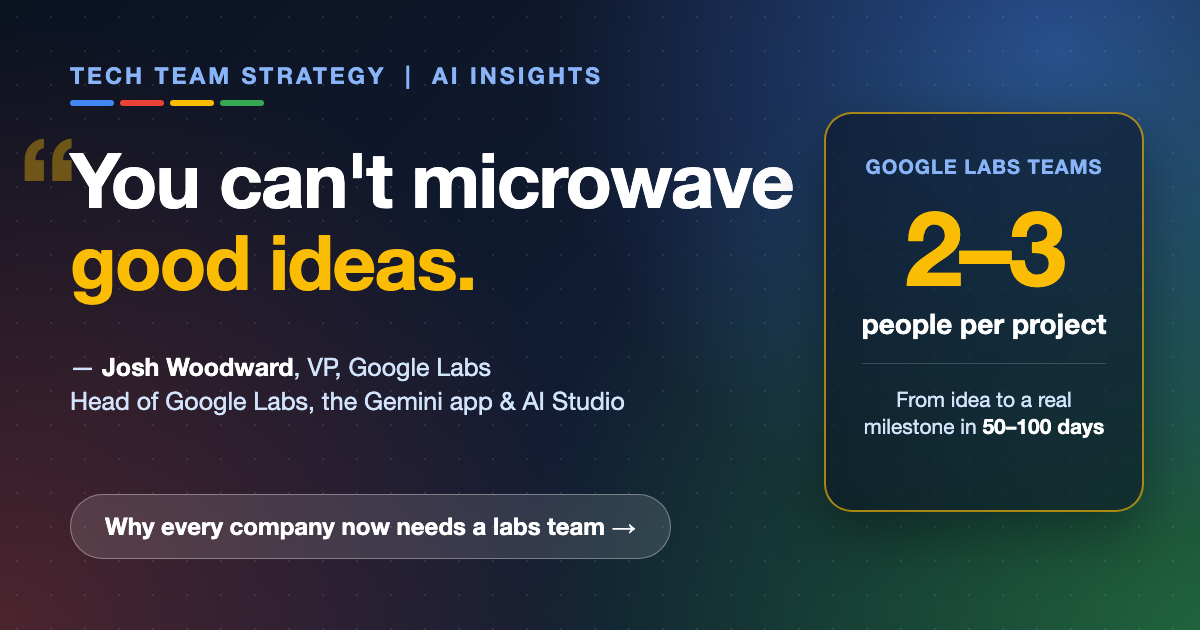
- You can't microwave good ideas. They come from small, obsessed groups and side projects, rarely from design sprints.
- Keep an "almost possible" list. When a capability crosses over, put a team on it right away.
- Product-market fit is in people's eyes. Early on, watch faces, not dashboards.
- The team knows before the leader knows. Make it safe to say "this isn't working".
- Small teams, short cycles. Two or three people per project, rolling six-month plans, a real milestone in 50 to 100 days.
- Labs fail when they can't bridge back. Independence, a clear game, and someone who can say a toy today will be essential in five years.
Why every company now needs a labs team
Lenny's thesis is simple: the technology everyone builds on is changing so fast that every company must get very good at trying the latest models and "figuring out what is now possible before your competition does." Woodward agrees, with a caveat: "I think your premise is spot on. I think the devil's in the details."
His point is that every startup is already a lab. The challenge is bringing that energy into medium and large teams. You need a few people plugged into the hive mind of model releases and new tools. In his words, "they're the people who have like eight $200 a month subscriptions on everything." They make it possible for the rest of the company to focus.
Where great ideas come from
Not from the calendar. "They very rarely, at least in my experience, have come from design sprints." Google Labs' hits, including NotebookLM, Flow, AI Studio and Google Beam, started with very small groups who were obsessed and curious and "just won't stop," often on a weekend or over a break.
"You can't microwave good ideas." (Josh Woodward)
The first NotebookLM audio overview is his favorite example. Two team members brought him a clip where two AI hosts discussed British Parliament debates, "not known for its riveting material," in a way that was genuinely interesting. Flow grew out of an earlier project called Whisk, which let people blend images and animate them.
The "almost possible" framework
Google Labs keeps a list of experiences that are almost possible, organized by future areas such as software development, creativity, knowledge work and immersive entertainment. When a model crosses a threshold in speed, languages or modality, an item flips: "It's almost like a phase shift... You're like, ooh, that just became possible." Then a team forms around it.
The team even wrote 82 predictions about the future, each starting with "We believe the future is" or "We predict". Woodward expects "9.9 out of 10" to be wrong, but says you have to "throw yourself out there and try to live in it a little bit." And technology alone is never enough: "You've got to kind of match that to an interesting user problem," ideally one people will pay to solve.
How to recognize product-market fit early
"It is way more art than science. I wish it was science." In the early days, the metric is not daily active users or retention:
"When you're showing people early prototypes... you're looking at people's eyes, and like that is the metric." (Josh Woodward)
If eyes light up and people lean in, you have a signal. His other rule: fall in love with the problem, not the product, because it often takes three, four or five pivots before something works. When it does, as with Nano Banana in Gemini or NotebookLM's audio overviews, "you're literally just swarming it and holding on for dear life."
When to kill an idea
"The team usually knows before the leader knows." The signs: the passion runs out, and you have tried everything you can think of. The leader's job is to create a culture where people can say so. The day before the recording, a Gemini PM recommended not launching a feature the team loved, after early testing showed it wasn't there. Woodward thanked her.
Skills rising in value: unlearning rate, explosive endurance, trust
- Unlearning rate. "How fast can they learn something and then walk away from it?"
- Explosive endurance. A phrase from a book about Roger Federer: going very hard, but for years, by pacing yourself and the people around you.
- Building trust at scale. With people and with swarms of AI agents. Labs project teams have shrunk from five to seven people to two or three, who team up like "super talented musicians... they play different songs together."
He also pushes back on the idea that everyone is becoming the same "builder". "People still have their specialty. It's like their major or minor in college." His advice to junior PMs: vibe code, but "don't lose that major."
Plan in seasons, six months and 100 days
With 20 to 30 experiments running at once, Labs names its seasons: explosive periods before a big model launch, and exploration after. June, after Google I/O, is for hacking, which is where "all the new seeds are coming from for like the next season." The roadmap is a rolling six months ("We have a six-month roadmap... we have a multi-year vision"), and the best teams go from idea to a meaningful milestone in 50 to 100 days.
How to set up a labs team that lasts
Most corporate labs fizzle, or invent the future and let someone else commercialize it. Woodward's three tips:
- Create a space where weird things can grow. Don't nestle it under an existing business unit; give it independence, sometimes a line to the CEO.
- Be clear about the game. Users first, company second, lab third. Decide whether the lab graduates work into existing products or invents new categories.
- Use the lab to change how the company works. Google Labs piloted a builder job ladder before Google rolled it out. "Lab sometimes creates good trouble at Google."
The people he hires can't stop building. "Hey, let me show you this thing I just built. Instant credibility." And the mistake he warns about most is hiring too fast: he once had 30 engineers, "zero product market fit, but a very inspiring vision."
Culture rituals worth copying
- The TPU Harvester: a miniature rake and a cash award for people who reclaim compute.
- The golden band-aid: for fixing the small paper cuts that annoy users.
- The LLM whisperer: a giant set of ears and a mechanical keyboard for pushing models in surprising ways.
- The good meeting: a scary-looking invite with no agenda, where leaders take turns saying why they value someone. "This is not a bad meeting. This is a good meeting."
What to do with it in your business
- Name a frontier team. Even two people, with a budget for AI subscriptions and time to play.
- Start your "almost possible" list. Review it monthly and act when something crosses over.
- Test in person. Show prototypes to customers and watch their eyes before you look at metrics.
- Love the problem. Write it in one sentence before naming a solution, and expect pivots.
- Make stopping safe. Thank the first person who says "this isn't working".
- Plan in short windows. Six-month rolling plans, one meaningful milestone every 50 to 100 days.
- Hire builders. Ask candidates to show you something they built, and look for a high unlearning rate.
- Keep it safe while you move fast. Our AI Policy Pack gives your team clear rules for experimenting with AI.
Get the detailed Executive Brief
Our Executive Brief: Josh Woodward on Why Every Company Needs a Labs Team goes much further than this article:
- The case for a labs team in every company, with his own words
- Twelve numbers worth remembering, clearly attributed
- Fourteen themes explained, each backed by short quotes with timestamps
- The 0-to-1, 1-to-10 and 10-to-100 lifecycle and six requirements for your own lab
- Culture rituals, a 12-point checklist, six leadership questions and a 30-60-90 day plan
- A quote bank of 20 more lines and a timestamped chapter guide
Video details
- Title: Why every company now needs to think and operate like a lab team | Josh Woodward (VP Google Labs)
- Host: Lenny Rachitsky (Lenny's Podcast)
- Guest: Josh Woodward, head of Google Labs, the Gemini app and AI Studio; more than 16 years at Google
- Channel: Lenny's Podcast on YouTube, about 649,000 subscribers
- Published: October 11, 2026
- Length: 1 hour 2 minutes 11 seconds
- Audience (as of October 29, 2026): about 80,000 views, 780 likes and 38 comments
- Category: People & Blogs
- Episode transcript (official): lennysnewsletter.com
- Sponsors named in the episode: WorkOS, DX
- Products referenced: Google Labs, Gemini Notebook (NotebookLM), Google Flow, Google Beam, Nano Banana, Google Stitch, Gemini Spark, Gemini Personal Intelligence
- Recommended book: The Master: The Long Run and Beautiful Game of Roger Federer
- Follow the guest: X, LinkedIn
- Follow the host: Newsletter, X, LinkedIn
- Watch: youtube.com/watch?v=3I6QYkccd3o
Chapters
- 00:00:00 Introduction
- 00:02:53 Why every company now needs to think like a labs team
- 00:05:43 Where great ideas come from
- 00:07:43 The "almost possible" framework
- 00:11:52 Finding product-market fit
- 00:16:09 Falling in love with the problem, not the solution
- 00:17:57 When to kill an idea
- 00:19:35 Overseeing Google Labs and the Gemini app
- 00:22:21 Next consumer AI breakthroughs
- 00:24:32 Google's vision for a personal assistant
- 00:27:18 What is overhyped and underhyped in AI right now
- 00:31:36 Skills rising in value: unlearning rate, explosive endurance, trust
- 00:35:45 Why roles are not blurring into one universal builder role
- 00:38:59 Explosive endurance rhythms
- 00:41:31 How planning has changed: rolling windows and 100-day milestones
- 00:43:37 Labs lifecycle stages
- 00:47:37 Tips for setting up an internal lab
- 00:54:00 The future of products in an AI world
- 00:56:26 Google Labs culture, rituals, and closing thoughts
Want to put this to work?
We help owners and founders set up small, fast AI teams and turn experiments into products. Book a free call or see our services.