
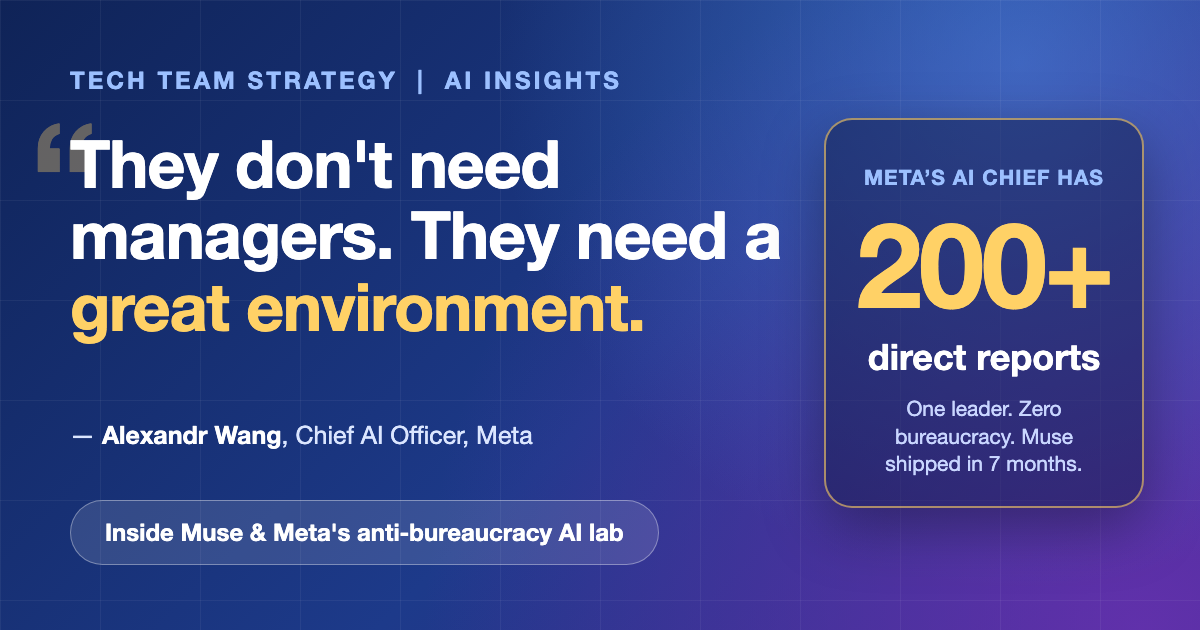
Ask most executives how many people report to them and you will hear seven, maybe ten. Ask Alexandr Wang, Meta's Chief AI Officer and co-founder of Scale AI, and the answer is: "I think more than 200."
That is not a management accident. It is the design of Meta Superintelligence Labs (MSL), the lab Wang was brought in to rebuild after Llama 4, and the team that shipped Muse, Meta's personal AI agent, in seven months. In a 72-minute conversation with David Senra published on October 11, 2026, Wang explains how it all happened.
This article is our own summary, written for owners and leaders of growing businesses. Statements below are as described in the interview and we have not independently verified them. Short quotes are lightly edited for filler words. Watch the full video above for everything that was said.
Want the full story? Our detailed Executive Brief on Alexandr Wang and Muse covers ten themes with his own quotes and timestamps, twelve key numbers, a 12-point checklist and a 30-60-90 day plan.
The short version
- More than 200 direct reports, on purpose. Every researcher in MSL's TBD group reports to Wang. "TBD is like literally anti-bureaucracy."
- Prototype in two weeks, polish for seven months. Muse's first version was demoed to Meta's board within one to two weeks. Making it reliable took the rest.
- "Ready" was defined with numbers. More than 100 behaviors, each with a launch-blocking threshold. Checkpoints green on 80 rows and red on 20 were rejected.
- Small team, one point of view. Fewer than 200 people built Muse, and Nat Friedman's taste set the direction.
- Personal, not coding. While the industry raced Anthropic on coding agents, Meta bet on consumer AI and its 3.5 billion daily users.
- A 49% deal and a refounding. Meta took 49% of Scale AI, Scale kept going, and Wang came over to rebuild a lab that "looked like damaged goods."
Why 200+ direct reports works for Meta's AI lab
Wang describes MSL as "small, very flat, highly technical team, very high talent density." The researchers he hired have already proven they can do brilliant work, so he does not micromanage them. There is still structure where it matters: researchers work in pods, and pod technical leads make the technical calls. Big decisions are debated as a group.
He is candid about the trade-off: he would be lying if he said he was the best manager to more than 200 people. "But this part of the point is that they don't need managers. They need a great environment." As he put it: "They just need the room to cook."
The reason is the nature of the work. Wang splits work into diamond mining and building skyscrapers. Skyscraper work, like data annotation or package delivery, pays off in a straight line and you win by squeezing out 1% or 2% of efficiency at a time. That was Scale AI. Diamond mining, like frontier research or venture capital, has a power-law payoff: most ideas fail, and a few are worth a million times the rest. That is MSL, and it needs freedom more than oversight.
Building Muse: two weeks to prototype, seven months to trust
The vision started with Mark Zuckerberg's June 2025 memo on Personal Superintelligence, written with Wang, Nat Friedman and others. In early 2026, Claude Opus 4.5 and the open source agent OpenClaw showed what personal agents could do. Friedman described his first OpenClaw experience as "somewhere between terrifying and euphoric." Wang ran a deep self-analysis prompt that felt like "the equivalent of like three years of therapy."
In February, the team built a prototype in one to two weeks and showed it to the board. Many ideas in it, including the Jolly mascot, made it into the final product. Then came the hard part. OpenClaw had faded because it only worked some of the time. Muse had to work every time, which meant "really grinding out and sanding out all of the details."
The team kept a spreadsheet of more than 100 behaviors a great personal agent needs, built an eval for each, and refused to launch until a specially trained Muse 1.3 checkpoint was green across the board. Wang gives Zuckerberg credit for the patience it took while Wall Street doubted Meta's AI spending: "Seven months in AI time, which maybe like a decade in like non AI time."
One point of view beats design by committee
Wang warns that products from large organizations turn into a blend of every manager's pet feature, "sort of like PM hell." Muse was protected from that. Even though it was one of Meta's most important launches of the year, it was kept to a small team because "we knew it was a single work of art."
How Muse broke through
- Get users to a "wow" fast. Onboarding explains that Muse is an agent, not a chatbot, and gets people to an early win.
- Build trust step by step. Users hand over a small task, then a bigger one. Wang calls it "this like trust fall almost that you have with an AI agent."
- Pass the screenshot test. "It has to work on the screenshot." The mascot in every screenshot instantly says "this is Muse".
- Lead with what it does for people. Most people do not care about the company or its research. "They care about like what it can do for them."
- Take risks in public. Wang's own meme posts on X helped Muse break through, because "the internet rewards risk and rewards like surprise."
Zuckerberg, Scale AI and the call that changed everything
Wang met Zuckerberg through Meta executive Alex Schultz; the first meeting took about a year to schedule. After Llama 4, which Wang calls "internally speaking a disappointment," Zuckerberg called him for advice. Five to six weeks later the deal was announced: Meta owns 49% of Scale AI, Scale continues, and Wang and a few colleagues joined Meta.
Leaving Scale after nine years was hard. Wang saw it as his life's work. What won him over was a deal good for every party, and the chance to refound a lab from scratch with the right principles and culture. He describes Zuckerberg as a leader who deliberates, then commits fully, and who believes "failure doesn't matter; it matters like when you win, how big you win."
From auteur to coach
At Scale, his first company, Wang lived by the rule that "if you want to be a good founder, you have to be able to do every job." That made him the bottleneck. At Meta he is a different kind of leader: he sets the north star, spots special talent and gives people the resources to do their best work. "I was the auteur" at Scale, he says; at Meta he thinks more like a coach. Senra's summary: he is the steward of a great environment.
The bigger idea: an escalator of agency
Wang's long-term view is that everyone will have a personal agent that supports what they want. His most striking line: "Muse can give everyone the adulthood they dreamed of in childhood." Instead of ambition being crushed by adult life, AI could offer "an escalator of agency": dream, achieve, dream bigger.
What to do with it in your business
- Bet where you have an edge. Your customers, data and relationships matter more than following the AI crowd.
- Prototype fast, launch slow. Build a rough version in two weeks, then polish until it is reliable.
- Write your launch list. List the behaviors your AI tool must get right with a pass bar for each. 80% green is a fail.
- Give every product one owner. Avoid design by committee.
- Design the trust ladder. Give customers and staff a quick win, then bigger tasks.
- Market the benefit. Lead with real customer use cases and screenshots.
- Manage research and operations differently. Freedom for bets, process for routine work.
- Remove one approval layer. Talented people need room to cook. Our AI Policy Pack helps you set clear rules so you can safely give that freedom.
Get the detailed Executive Brief
Our Executive Brief: Alexandr Wang on Building Muse and Meta's AI Lab goes much further than this article:
- The full story of the 200+ direct reports model, with five quotes in his words
- Twelve numbers worth remembering and a timeline from the Scale AI deal to launch
- Ten themes explained, each backed by short quotes with timestamps
- Founder vs. steward leadership comparison and diamond mining vs. skyscrapers
- A 12-point checklist, six leadership questions and a 30-60-90 day plan
- A quote bank of 18 more lines and a timestamped chapter guide
Video details
- Title: Building Muse, Working with Mark Zuckerberg & The Future of AI | Alexandr Wang, Meta
- Host: David Senra (David Senra podcast; host of Founders)
- Guest: Alexandr Wang, Chief AI Officer of Meta and co-founder of Scale AI
- Channel: David Senra on YouTube, about 141,000 subscribers
- Published: October 11, 2026
- Length: 1 hour 12 minutes 17 seconds
- Audience (as of October 28, 2026): about 470,000 views, 4,700 likes and 200 comments
- Category: People & Blogs
- Channel tags: david senra, founders, business, david senra podcast
- Show notes: davidsenra.com/episode/alexandr-wang
- Sponsors named in the episode: Ramp, Deel, AppLovin
- Follow the guest: X, LinkedIn, Instagram
- Watch: youtube.com/watch?v=S6l3aRsecuE
Chapters
- 00:00:00 The vision behind Muse
- 00:01:32 Discovering the potential of personal AI agents
- 00:03:34 Three years of therapy in one AI session
- 00:05:46 Building Muse in 7 months
- 00:09:16 Why Meta bet on personal AI
- 00:16:51 Mark Zuckerberg's obsession with improving products
- 00:20:15 How Meta knew Muse was ready to launch
- 00:23:32 Why great products need a single point of view
- 00:25:56 Making Meta cool again with memes
- 00:34:38 Building trust with AI agents
- 00:38:43 The future of human ambition
- 00:45:22 The call from Mark Zuckerberg that changed everything
- 00:52:13 Leaving Scale AI for Meta
- 00:55:19 Rebuilding Meta's AI lab from scratch
- 00:58:13 From founder to coach
- 01:05:55 The future billionaires at Alexandr's 19th birthday party
- 01:08:04 Diamond mining vs. building skyscrapers
- 01:09:21 Why Alexandr has more than 200 direct reports
Want to put this to work?
We help owners turn AI trends into a plan, a product and a launch. Book a free call or see our services.