
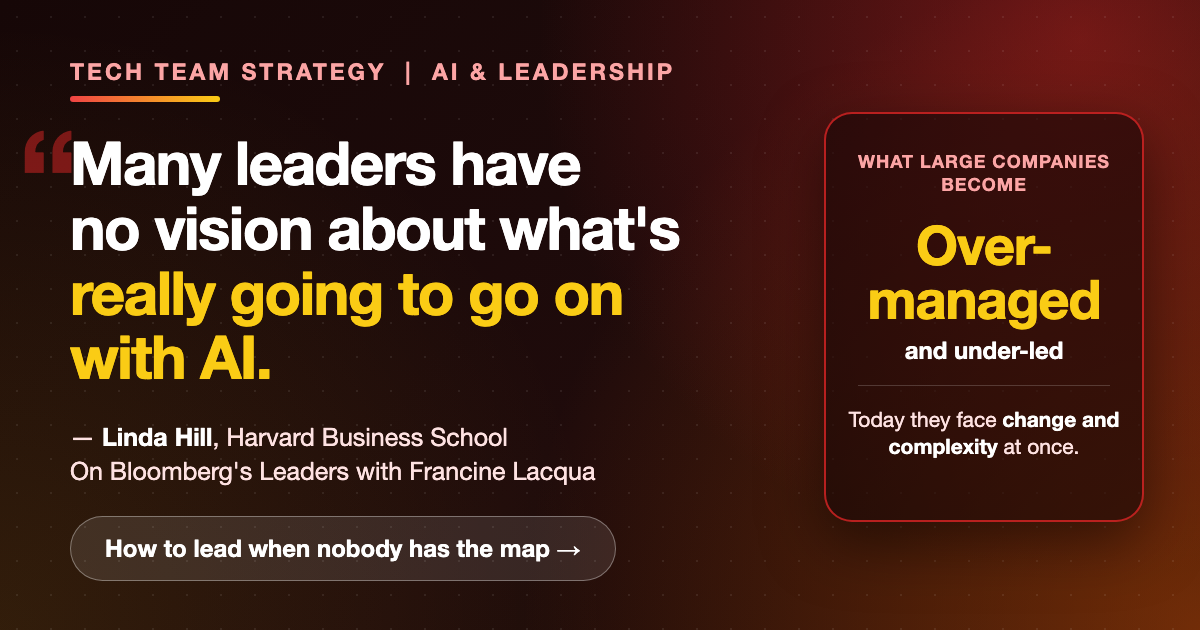
Ask CEOs where AI is taking their company and many can't tell you. Harvard Business School professor Linda Hill thinks that's honest, and that it changes what leadership means. "Many leaders have no vision about what's really going to go on with AI," she says. "They just don't. When you ask them, they're perplexed."
Hill, faculty chair of Harvard's Leadership Initiative and author of Becoming a Manager and Genius at Scale, spoke with Francine Lacqua on Bloomberg's Leaders podcast in a 24-minute conversation published on August 17, 2026. She covers what makes a great CEO, co-CEOs, hiring people smarter than you, charisma, and how AI is changing leadership.
This article is our own summary, written for CEOs, boards and managers. Statements below are as described in the interview and we have not independently verified them. Quotes come from the video's captions and are lightly edited for filler words and transcription errors. Watch the full video above for everything that was said, and sign in to read the full transcript below the article.
Want the full playbook? Our detailed Executive Brief on Linda Hill covers fourteen themes with her own quotes and timestamps, eight ideas worth remembering, a table of how leadership is changing, a 12-point checklist and a 30-60-90 day plan.
The short version
- On AI, most leaders have no vision. Lead by purpose instead, and find the way together ("wayfinding").
- Talk about risk appetite before you roll out AI. Boards avoid the conversation, but the differences play out anyway.
- Set decision rights. People closest to the news must be able to act, within guardrails.
- Watch for over-managed and under-led. Large companies drift there over time, just when they face both change and complexity.
- Formal authority is limited. Being "the boss" counts for less; collaboration will matter more in ten years.
- Amplify difference. Harness conflict between talented people instead of minimizing it.
- Your job is not to have all the answers.
Leading through AI without a map
Hill draws a line between vision and purpose (18:09). Vision means you know the direction and ask people to follow you there. But with a breakthrough innovation, by definition, nobody has the answer. That is where many leaders are with AI:
"What's happening right now is that many leaders have no vision about what's really going to go on with AI. They just don't. When you ask them, they're perplexed." (Linda Hill)
She calls the alternative wayfinding, as opposed to pathfinding: "We don't know the destination, nonetheless how we're going to get there." It takes confidence in your capacity to help people figure it out together.
Her example is the head of Cleveland Clinic Abu Dhabi, who told her he felt he was "leading through a fog." His answer was to tell the whole hospital there is no business as usual, that "everything is a working hypothesis," and that everyone must become an innovative problem solver. During COVID he made sure every decision team included someone who had never seen an epidemic, to ask the "stupid" questions experts wouldn't.
The AI conversation boards avoid: risk appetite
Boards and senior teams rarely talk about risk openly, Hill says (16:25). Members can have very different appetites for risk, but nobody names it, because board members don't like conflict. With AI, that silence is a problem:
"We need to say, what is our risk appetite, as we begin to, for instance, roll out AI solutions. And that conversation is a really hard one to have." (Linda Hill)
"It's there whether you bring it up or not," she adds. The trick is to have the conversation without making it personal, without labels like "you're too conservative" or "you're resistant to the future."
Fewer bosses, more decision rights
The CEO of the future, she says, must build "an agile organization that can adapt to anything." News reaches people down the line before it reaches you, so they need to be empowered to make the local decision, within guardrails, or know when to escalate. The first thing she works on with CEOs is decision-making rights: who decides what, what you need to hear before they decide, and how you work so you are comfortable delegating.
That shift also changes management. Hill's mentors John Kotter and Warren Bennis defined leadership as dealing with change and management as dealing with complexity, and found that large companies drift toward too much of one:
"Large companies over time, for very logical reasons, will be over-managed and under-led." (Linda Hill, describing their findings)
Today, she notes, "we have complexity and change happening now."
And the advice she disagrees with most? "That you need to make sure that people know you're the boss" (23:03). Many people still want a clear boss, she admits, but:
"I think formal authority as a source of power is actually quite limited in many ways in what you need to do now to influence people to get the job done." (Linda Hill)
The skill that will matter more in ten years: "your capacity to collaborate."
What makes a great CEO
- Know yourself, and drop the need for answers. "Your job is not necessarily to have all the answers." Being more vulnerable gets you more help, and asking for help gets harder as you rise.
- Contextual intelligence. Before calling someone good, bad or resistant, ask what in their context drives that behavior, and what constraint you could remove.
- It's not about you. "You need CEOs who fundamentally know that they're there for the enterprise." Think duties and obligations, not rights and privileges.
- Connection. If people can't connect with you, they won't co-create the future with you, "and that's when you know there's going to be a failure."
Amplify difference, and get feedback
Hill calls it creative abrasion: "You need to amplify difference. But many CEOs minimize difference" (6:23). Everyone has a "slice of genius," and talented, passionate people don't let go of their ideas easily. An early Google infrastructure leader told her you can never have too many cooks in the kitchen; it is on the leader to get them working together.
Feedback gets scarcer the higher you go. At Pixar, Ed Catmull would tell Steve Jobs not to come to certain meetings because his presence would throw off the group. Jobs understood that "most action that happens is collective action." "As you become more senior, people don't give you feedback," Hill says, so build an organization that tells you when problems appear.
Charisma, co-CEOs and portable talent
- Charisma is "a source of power," but she was more struck by how deliberate Celtics coach Joe Mazzulla was, caring for each player and building ties with business operations, the city and the media on the way to the team's 18th championship.
- Co-CEOs work "if they get along very well together. And if they can be honest with each other," with a clear division of labor, for example one building the future while the other runs the core.
- Talent doesn't travel well. Research by her colleagues Boris Groysberg and Nitin Nohria found that CEOs often struggle in a new company because they can't bring the network of relationships that made them successful.
- Empowerment is overrated as people use it. It means sharing the potential to have influence; whether people get to use it is still the leader's call.
What to do with it
- Be honest about AI. Tell your team what you don't know, and invite them to find the way with you.
- Hold the risk-appetite conversation on AI with your board or senior team, without labeling anyone.
- Write down decision rights for AI tools and data: who decides, and what gets escalated.
- Count the layers. Check whether you are over-managed and under-led.
- Add a beginner to every AI decision team.
- Invest in collaboration over formal authority.
- Set clear AI rules. Our AI Policy Pack gives your team clear rules for using AI tools safely.
Get the detailed Executive Brief
Our Executive Brief: Linda Hill on Leading Without a Vision for AI and the Limits of Being the Boss goes much further than this article:
- How to lead through AI without a map, in her own words
- Eight ideas worth remembering, clearly attributed
- Fourteen themes explained, each backed by short quotes with timestamps
- A table of how leadership is changing
- A 12-point checklist, six questions and a 30-60-90 day plan
- A quote bank of 20 more lines and a timestamped chapter guide
Video details
- Title: The Leadership Skills for CEOs That Will Matter Most in the Age of AI
- Host: Francine Lacqua, Leaders with Francine Lacqua, Bloomberg
- Guest: Linda Hill, professor of business administration at Harvard Business School and faculty chair of its Leadership Initiative; founder of the consultancy Paradox Strategies
- Channel: Bloomberg Podcasts on YouTube, about 608,000 subscribers
- Published: August 17, 2026
- Length: 23 minutes 38 seconds
- Audience (as of November 2, 2026): about 568,000 views and 7,100 likes
- Category: News & Politics
- Official description (excerpt): "After spending decades advising CEOs and studying leadership, Harvard Business School professor and author Linda Hill has developed a clear view of what makes great leaders — and where many fall short." She explains why the most successful executives prioritize collaboration over charisma, embrace constructive conflict and build organizations that adapt, and how AI is reshaping leadership.
- More: Bloomberg Podcasts
- Watch: youtube.com/watch?v=8-MR5mtO36c
Chapters
- 00:00:00 Leaders with Francine Lacqua: Introducing Linda Hill
- 00:01:27 What makes a great CEO?
- 00:03:30 Why more companies are choosing co-CEOs
- 00:06:41 Why the best leaders hire people smarter than themselves
- 00:09:49 Does charisma really make a better leader?
- 00:15:52 How AI is changing the future of leadership
Want to put this to work?
We help founders and leaders build strong teams and put AI to work across the company. Book a free call or see our services.