
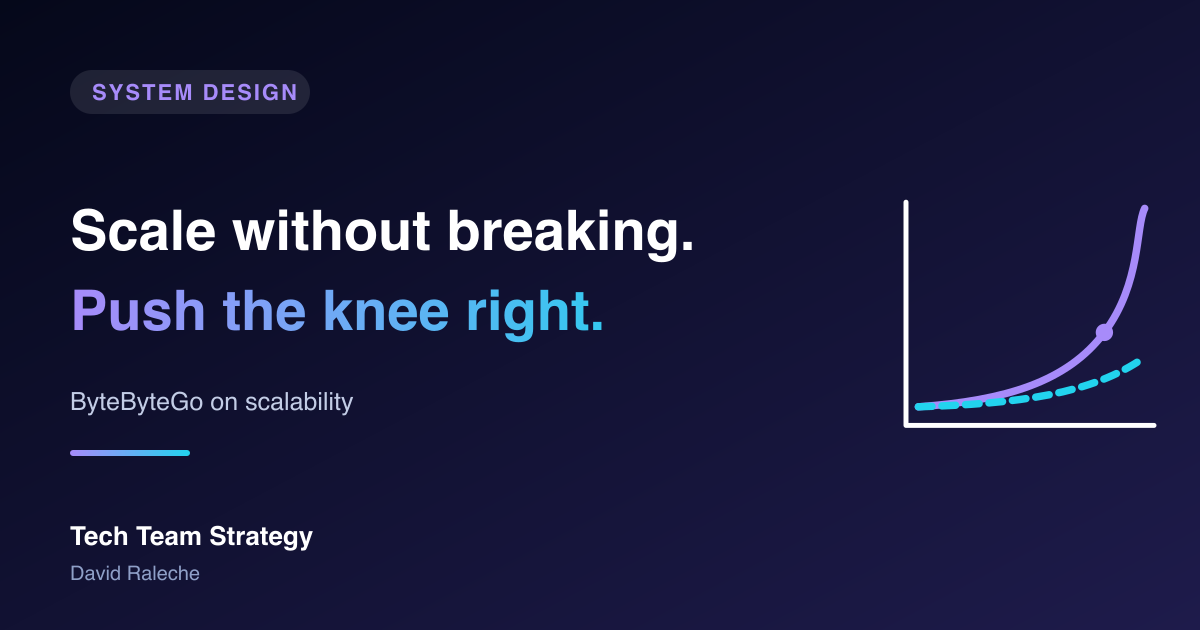
ByteByteGo, the team behind the System Design Interview books, explains scalability in about ten minutes: what it means, what stops systems from growing, the three principles that help, and the techniques large systems use to stay "rock-solid under pressure" when an app goes viral overnight.
Disclosure: the video ends with a promotion for the creator's newsletter. We have left it out of this summary.
This article is our own summary, with short quotes, from the video's automatic transcript. Watch the full video above for everything that was said.
The short version
- Scalable means efficient growth. A system scales if it handles more load by adding resources, without hurting performance and at a reasonable cost.
- Compare, don't label. Plot response time against demand; the more scalable system has the flatter curve, and every system eventually hits a "knee."
- Two bottlenecks: centralized components and high-latency operations.
- Three principles: statelessness, loose coupling and asynchronous processing.
- Two strategies: vertical scaling (a bigger machine) and horizontal scaling (more machines).
- Five techniques: load balancing, caching, sharding, avoiding centralized resources and modular design, plus constant monitoring.
What scalability really means
At its core, a system is scalable if it can handle increased load by adding resources without compromising performance. But it is also about doing so cost-effectively. Adding processors or servers raises questions: how do they coordinate, and will the coordination overhead eat the gains?
It is more useful to compare systems than to call one "scalable." Draw a response vs. demand curve: demand on the x-axis, response time on the y-axis. A more scalable system's curve rises less steeply. No system is infinitely scalable; the point where performance drops fast is the knee, and the goal of system design is to push it as far right as possible.
What causes bottlenecks
- Centralized components, like a single database server handling every transaction, set a hard upper limit.
- High-latency operations, like slow data processing, drag down response time no matter how many resources you add.
When a central component is required for business or technical reasons, soften its impact with optimization, caching or replication.
Three principles for systems that scale
- Statelessness. Servers don't keep client data between requests, so any server can handle any request and losing one loses nothing. When state is needed, such as user sessions, move it to a distributed cache or database.
- Loose coupling. Components talk through well-defined interfaces or APIs, so one can be changed or replaced without ripple effects, and a single bottleneck service can be scaled out on its own.
- Asynchronous processing. Instead of calling each other and waiting, services emit and listen for events. This avoids blocking and cascading failures, at the cost of harder error handling, debugging and data consistency.
Vertical vs. horizontal scaling
Vertical scaling (scaling up) means a bigger machine with more CPU, RAM or storage. It is simple and suits systems that are hard to distribute, like some databases with strict consistency needs, but it has physical limits and costs climb steeply near the top.
Horizontal scaling (scaling out) adds more machines working in parallel. It fits cloud-native apps, tolerates failures better and is often cheaper at large scale, since capacity can follow demand. The trade-off: data consistency, network overhead and the complexity of distributed systems.
Techniques that work
- Load balancing: the "traffic cop" that spreads requests with algorithms such as round-robin, least connections or performance-based routing, so no server is overwhelmed while others sit idle.
- Caching: a short-term memory boost on the client, the server or a distributed cache, plus a CDN to serve users around the world faster.
- Sharding: splitting large datasets across servers. Choose shard keys from real access patterns to spread the load evenly and avoid hotspots and cross-shard queries.
- Avoid centralized resources: use several queues instead of one, break long tasks into small parallel ones, and use patterns like fan-out and pipes and filters.
- Modularity: loosely coupled modules avoid the monolith trap, where a change in one place breaks another.
Scaling never stops
Watch CPU, memory, network bandwidth, response times and throughput to find bottlenecks and decide when to scale. "What works today might not be sufficient tomorrow," so revisit design decisions as the product grows.
What it means for your business
- Measure the curve. Load-test your app and find where response time bends before your customers do.
- Keep web servers stateless so you can add or remove them freely.
- Find the single points. List every component there is only one of, and plan caching or replication for it.
- Scale up first, out when needed. A bigger machine is often the cheapest early fix; design so you can scale out later.
Video details
- Title: Scalability Simply Explained in 10 Minutes
- Creator: ByteByteGo
- Published by: ByteByteGo on YouTube
- Watch: youtube.com/watch?v=EWS_CIxttVw
- Note: quotes and details come from the video's automatic transcript and are lightly cleaned. Check the video for exact wording.
Want to put this to work?
We help owners turn AI trends into a plan, a product and a launch. Book a free call or see our services.